
Hey, what’s up?

The past few months have been quite hectic, with back to back weekend shifts at work and travelling in between an already packed schedule. As a result, reading novels has practically become a thing of the past. I honestly can’t remember the last time I sat down and properly enjoyed a book!
Since I’ve finally got some time to spare this weekend, I decided to finish a book and write a review. It’s been a while, hasn’t it?
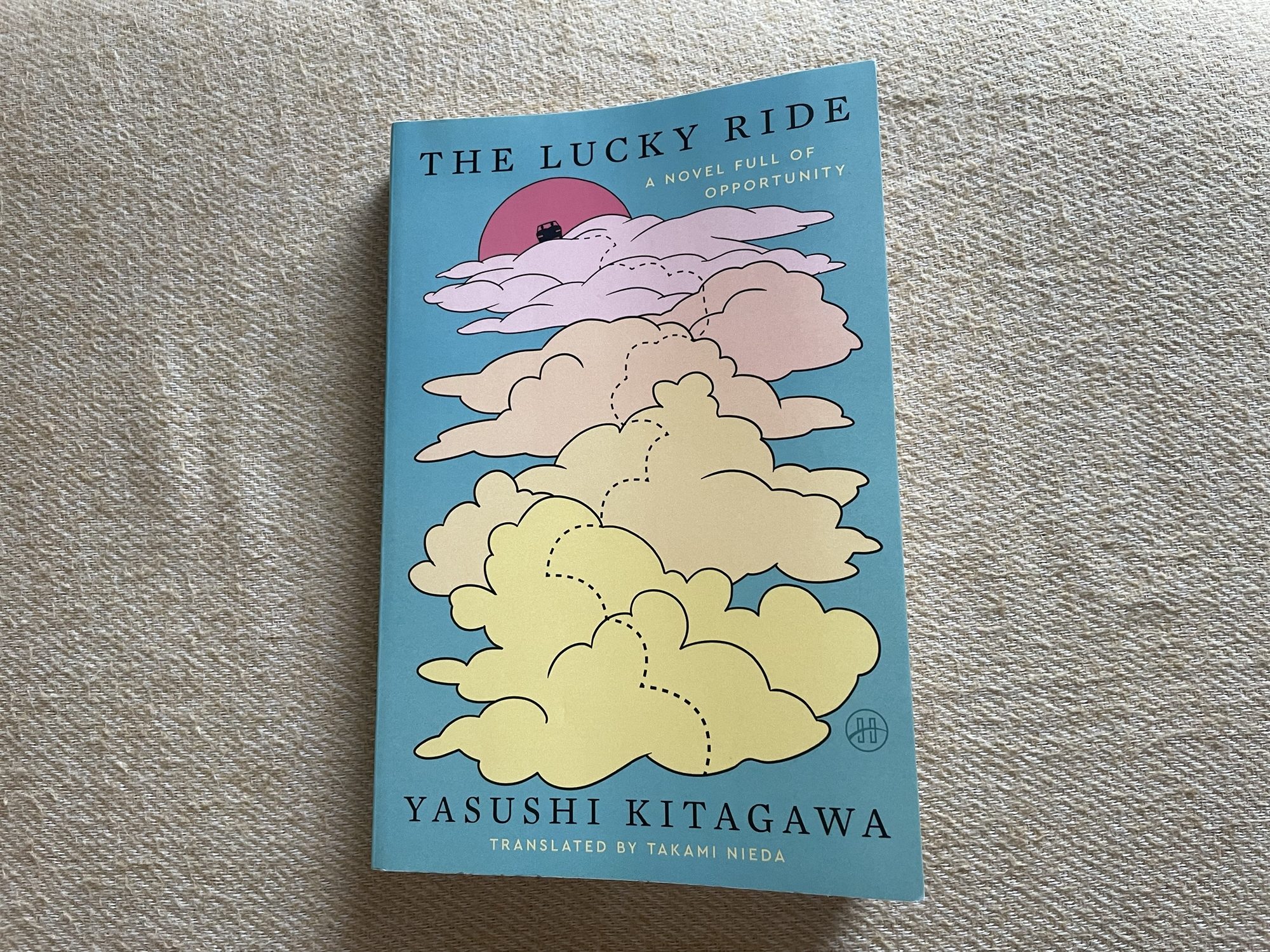
This time, I’ll be reviewing a book titled The Lucky Ride by Yasushi Kitagawa, a Japanese author. The book was originally written in Japanese and subsequently translated into English by Takami Nieda. This is my first time reading a book translated by Nieda, and I must say that he’s done a great job of conveying the author’s message in English. The writing felt natural and easy to follow, which made the reading experience even more enjoyable.
Before getting into the actual content of the book, let’s talk about its cover illustration for a moment. It appears to show a car leaving tyre marks across several clouds in different pastel colours, seemingly heading towards either the moon or the sun. I’m still not entirely sure which one it is!
Interestingly, one of the reasons I picked up this book was because I couldn’t quite figure out what the cover was supposed to represent. There was something intriguing about it, and that curiosity eventually convinced me to give the book a read. I suppose the cover did its job after all!
Now, let’s get into the story without spoiling too much. Hopefully.
The novel revolves around an insurance salesman who has recently lost quite a number of clients and is also struggling with several issues in his family life. Things haven’t exactly been going his way. One day, he gets into a taxi that takes him to various places, each of which has the potential to change his luck and, ultimately, his life.
Throughout the journey, the taxi driver shares several pieces of advice on how to increase one’s chances of encountering life changing opportunities. What initially seems like an ordinary taxi ride gradually becomes something much more meaningful.
One particular idea that stuck with me was the taxi driver’s analogy of luck being similar to a gift card. The more credit you accumulate on the card, the more you have available to spend. According to this analogy, luck works in a similar way.
The idea is that nobody is simply born lucky or unlucky. Instead, luck is something that we can accumulate through our actions and choices. We can then spend it gradually over time or use a significant amount when a major opportunity comes along.
At least, that’s how I interpreted it!
I thought it was quite an interesting way of looking at luck, especially since I’ve never really considered it from that perspective before. I’m not entirely sure whether I’ve explained the analogy as clearly as the author intended, but I think you’ll have a much better understanding of it once you’ve read the book yourself.
Overall, I’d give this book a 7/10.
I genuinely enjoyed reading it, particularly because it offered a different perspective on something as abstract as luck. It certainly gave me something to think about after finishing the book.
The main reason I didn’t rate it any higher is that, as a Muslim, I personally have a different understanding of luck and how events unfold in our lives. Some of the ideas presented in the book don’t entirely align with my own beliefs, although I can still appreciate the message the author was trying to convey.
But let’s not get into that discussion today, because I have a feeling this book review would turn into a very lengthy philosophical and religious discussion!
Regardless, I think it’s a fascinating read, and I appreciate how the author encourages readers to reflect on their actions, choices and outlook on life. If you’re planning to read this book, I hope my review has given you a little insight into what to expect without giving too much away.

On a slightly unrelated note, I thought I’d share the bookmark I used while reading this book! I got it during my trip to Istanbul, and it features what looks like a typical Ottoman style mosque overlooking the water, which I assume is the Bosphorus. It’s a lovely little souvenir, and I thought it deserved a brief appearance in this review.
To wrap things up, here are a few quotes from the book that I particularly liked:
Good things don’t happen without you taking a corresponding action.
That one’s efforts will always be rewarded.
It’s perfectly fine to want things.
As always, thank you for taking the time to read my review. I hope you enjoyed it, and perhaps I’ve inspired you to pick up a book yourself this weekend!
Until next time, happy reading!
Leave a Reply